
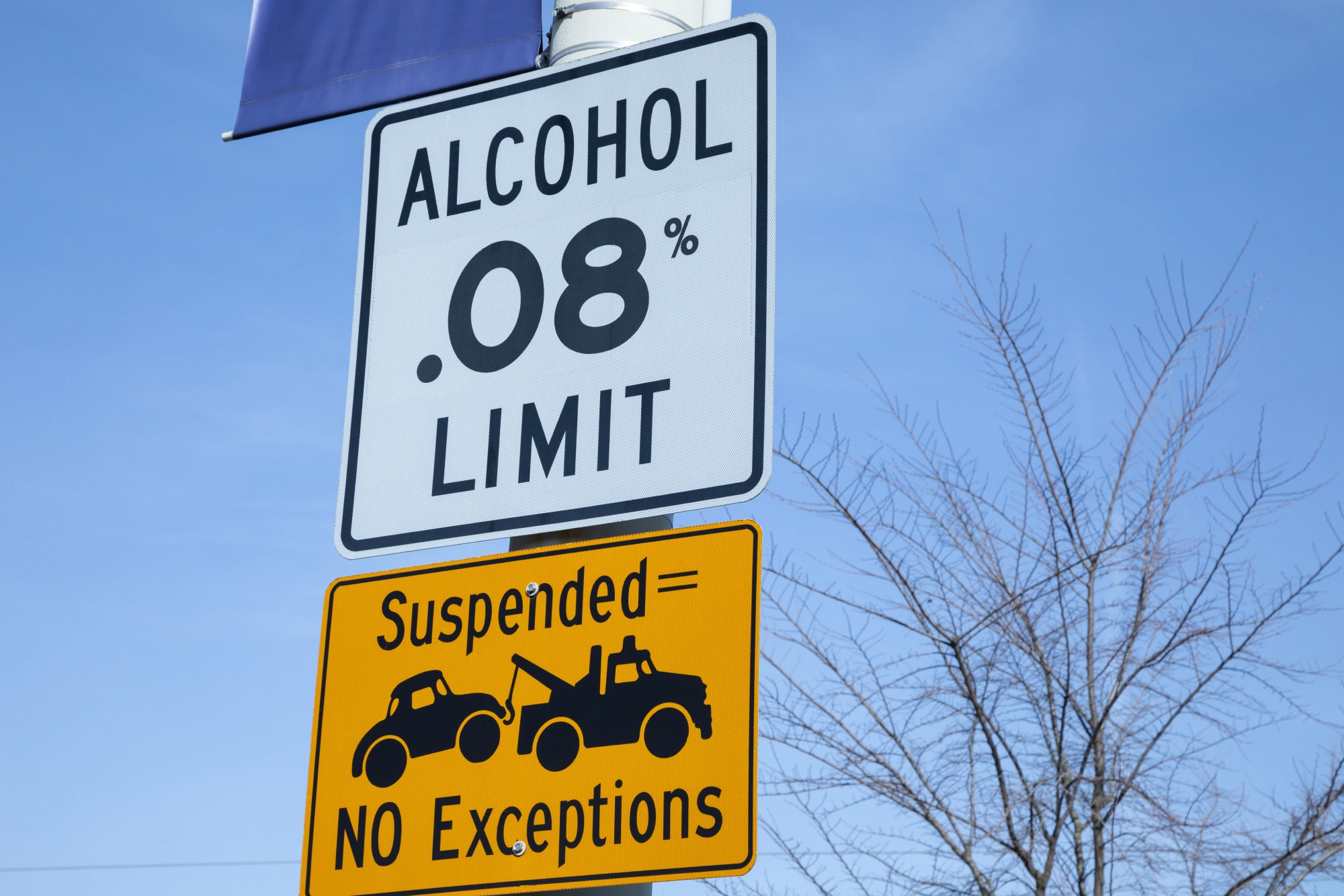
While the legal limit for alcohol in Texas is 0.08%, that single figure doesn't tell the whole story. Texas law sets different legal limits depending on who is behind the wheel, and it's entirely possible to be arrested for driving under the influence in Texas even if a breath or blood test comes back under 0.08%.
This guide walks through the exact legal limits for adult, commercial, and underage drivers, shows roughly how many drinks it takes to reach those thresholds, and explains how your specific BAC level can change the penalties you're facing.
Whether your stop happened in Houston, Conroe, or Bryan, Ned Turnbull and Turnbull Legal Group can help. Contact us online today or call us at (832) 314-3232 for a free consultation to put a former judge and chief prosecutor in your corner.
The legal BAC limit in Texas: 0.08% for standard drivers
Under Texas Penal Code § 49.01, a driver age 21 or older is considered legally intoxicated once their BAC reaches 0.08%. This is what's known as a “per se” limit, meaning that once your BAC hits that number, you're legally presumed intoxicated regardless of how well you feel you're driving or how coherent you feel.
Law enforcement can establish this number through a breath test, blood draw, or, in some cases, a urine test. Because 0.08% is a bright-line number, it forms the backbone of the standard Texas DWI charge, but as we will soon explain, it is far from the only number that matters.
The legal limit for minors: zero tolerance under 21
Texas takes a dramatically different approach when the driver is under 21. Instead of a 0.08% threshold, the state applies a zero-tolerance standard under the Texas Alcoholic Beverage Code. For drivers under the legal drinking age, any detectable amount of alcohol in their system while operating a vehicle can lead to a citation for DUI — a separate, lower-level offense from a standard DWI, but one that still carries real consequences.
Consequences for underage drivers caught with any measurable alcohol typically include the following:
- A fine of up to $500 for a first offense
- Mandatory alcohol awareness classes
- Community service hours
- Driver's license suspension, which increases in length with repeat offenses
If a minor is stopped with a BAC of 0.08% or higher, prosecutors can still pursue a standard DWI charge instead of the lesser DUI offense, which exposes a young driver to jail time and a permanent criminal record.
Because the zero-tolerance standard applies at any detectable level, a single drink can technically put a minor driver at risk.
The legal limit for commercial drivers: 0.04%
Drivers operating commercial motor vehicles face a stricter legal limit of 0.04% BAC — half the threshold that applies to a standard passenger vehicle. This lower limit applies any time a commercial driver's license holder is operating a commercial vehicle. So as little as a drink or two, a BAC level that wouldn't result in charges for an ordinary driver in a personal car can trigger a CDL DWI.
You should also know that a standard 0.08% arrest in a non-commercial vehicle can still trigger federal disqualification rules for commercial license holders. This means that CDL holders can lose commercial driving privileges for DWI convictions even if the arrests happen while they are driving their own personal vehicles off the clock.
Factors that affect BAC beyond drink count
The charts in this article are useful starting points, but BAC is not just a function of how many drinks you had; it's a function of how your specific body processes alcohol over a specific window of time. Two people who had the identical number of drinks at the same bar can register very different BAC results depending on individual physiology and circumstances.
Some variables that can meaningfully shift your BAC up or down relative to a generic chart include:
- Rate of consumption: Drinking quickly concentrates alcohol in your bloodstream faster than your liver can process it
- Food intake: Alcohol consumed on an empty stomach is absorbed more rapidly
- Body composition: Muscle and fat retain and dilute alcohol differently, which is part of why weight-based charts are only estimates
- Medications: Certain prescriptions and over-the-counter drugs can intensify alcohol's effects
- Time elapsed since your last drink: Your body eliminates roughly one standard drink's worth of alcohol per hour, so BAC can still be rising when you get behind the wheel
Because so many personal factors are in play, relying on a mental chart to estimate your own BAC before driving is inherently risky. Officers and prosecutors rely on chemical testing and observed impairment, not a driver's own math.
How many beers can you drink and drive in Texas?
As we’ve just explained, the science of blood alcohol content is complicated. This means that there is no universal answer to how many beers you can drink and remain under the legal limit in Texas. BAC depends on body weight, sex, metabolism, food intake, and the amount of time spent drinking, not just the number of drinks.
That said, the chart below offers rough estimates for how many standard 12-ounce beers (each containing about 0.6 ounces of alcohol) it typically takes to reach 0.08% BAC after roughly one hour of drinking.
These numbers are estimates only. Because BAC keeps climbing for a period even after you stop drinking, and because impairment itself (not just the number on a breath test) can support an arrest, the only truly safe approach is to avoid driving after drinking altogether.
How many drinks is 0.08%? Comparing beer, wine, and liquor.
Because standard drink sizes vary by beverage type, the answer depends on what you're drinking, not just how much. A standard drink is generally defined as roughly 12 ounces of regular beer, 5 ounces of wine, or 1.5 ounces of distilled spirits, each of which contains a comparable amount of pure alcohol despite the different serving sizes.
Because each of these “standard drinks” delivers a roughly equal dose of alcohol, the beer chart above should translate reasonably well to wine or liquor.
The issue is that this is all very imprecise. This is further complicated by the fact that cocktails have much more than 1.5 oz of alcohol in them and beer is often sold in pints; bars and restaurants don’t care about the “standard size” of a drink or about measuring your blood alcohol content, so even if you believe you can have 4 drinks in an hour and stay under the legal limit, 2 drinks from a generous bartender could put you over.
Is 0.15% a high alcohol level? Enhanced penalties for high BAC.
Yes. A BAC of 0.15% or higher is treated as a high, aggravating alcohol level under Texas law, nearly double the standard 0.08% threshold. Once a driver's BAC reaches that point, the offense is enhanced from a Class B misdemeanor to a Class A misdemeanor, which carries significantly harsher potential penalties even for a first-time offender.
Here’s a look at the penalties for a first-time DWI based on BAC:
A 0.15% reading doesn't just increase the potential jail time and fine; it can also affect plea negotiations, bond conditions, and whether a judge requires an ignition interlock device as a condition of release.
If you're facing an enhanced charge, the stakes of your case are meaningfully higher than a standard first-offense DWI. Prosecutors often treat a 0.15% result as evidence of a more serious pattern of drinking, which can influence how aggressively they pursue the maximum available penalty rather than offering a reduced plea.
How officers measure intoxication in Texas
When an officer suspects a driver is impaired, Texas law gives them a few different tools for measuring alcohol concentration, and the specific method used at your stop can matter a great deal to your defense. Under the state's implied consent law, anyone driving on a Texas road has technically already agreed to submit to breath or blood testing if lawfully arrested for DWI.
Before any chemical test is administered, officers typically rely on a set of standardized field sobriety tests to help establish probable cause for an arrest. These generally include the following:
- Horizontal Gaze Nystagmus (HGN): Tracking involuntary eye movement while following a moving object
- Walk-and-Turn: Walking heel-to-toe along a straight line and turning on command
- One-Leg Stand: Balancing on one foot for a set count while the officer observes for swaying or hopping
After an arrest, BAC is usually confirmed through a breath test at the police station or a blood draw at a hospital or jail facility. If a driver refuses testing, Texas law allows officers to seek a warrant for a mandatory blood draw, particularly when a crash involves injury. Because these tests, their calibration records, and the officer's documented observations all become evidence, errors or irregularities at any step can become central to challenging the State's case.
License suspension consequences by BAC and test refusal
A DWI arrest in Texas actually triggers two separate proceedings: the criminal case itself, and a civil Administrative License Revocation (ALR) process tied directly to your driving privileges. The ALR clock moves fast: you have only 15 days from your arrest to make your ALR hearing request, or your license is suspended automatically. How long that suspension lasts depends on whether you failed or refused testing, and whether you have prior offenses.
Refusing testing generally results in a longer suspension than failing it. In many cases, a suspended driver can apply for an occupational license that permits limited driving for work, school, or household needs while the suspension runs, but that process requires its own paperwork and, often, an ignition interlock device installed on the vehicle.
Texas legal limit and DWI FAQ
What’s the difference between DUI vs DWI in Texas?
Texas doesn't use “DUI” as a standalone charge for adult drivers the way many other states do. Instead, Texas primarily uses “DWI” (Driving While Intoxicated) for drivers 21 and older, while “DUI” is reserved specifically for drivers under 21 who are caught with any detectable alcohol under the zero-tolerance law described earlier.
Continue reading: DWI vs DUI in Texas
Is a first DWI a felony in Texas?
In most cases, no. A first DWI offense in Texas is typically charged as a Class B misdemeanor, or a Class A misdemeanor if BAC reached 0.15% or higher, an open container was present, or the driver had a minor passenger in the vehicle. It only becomes a felony under narrower circumstances, like when someone is seriously injured or killed in an accident. If you're facing a repeat charge, like a second DWI in Texas, the chances of facing felony DWI charges go up considerably.
Can you be charged with a DWI below the legal limit?
Yes. Texas's DWI law doesn't only rely on the 0.08% per se limit. It also allows prosecution any time a driver has “lost the normal use of mental or physical faculties” due to alcohol or drugs, regardless of the exact BAC number. This means a driver who tested at 0.06% or 0.07% can still be arrested and charged if an officer believes their driving, speech, coordination, or performance on field sobriety tests showed clear impairment.
Stopped over the legal limit? Talk to a Texas DWI attorney before it’s too late.
Knowing the legal limit for alcohol in Texas is only the starting point. How that number was measured, whether the stop and testing were conducted properly, and how your specific BAC lines up with the charge you're facing all shape the outcome of your case. Even if you failed a blood alcohol test after your arrest, the most important thing you can do to protect your future is hire a Houston DWI lawyer you can trust.
Looking for a Bryan DWI lawyer or a Conroe DWI lawyer? Ned Turnbull has seen DWI cases from every side of the courtroom, and he uses that to give your case the upper hand. The team at Turnbull Legal Group brings the rare perspective of a former judge and prosecutor to every DWI case we handle. If you or a loved one are facing DWI charges, contact us online today or call us at (832) 314-3232 and put a former judge in your corner.
More Helpful Articles by Turnbull Legal Group:
- Can You Refuse a Sobriety Test in Texas?
- Texas Open Container Law: What You Need To Know
- How To Beat a DWI in Texas
- What is an Aggravated DWI?
- How Long Does a DWI Stay on Your Record in Texas?
.webp)
Give Your Case Home-Court Advantage.
From criminal defense to personal injury, we bring perspective, strategies, and relationships that not many law firms can offer — and we use them to protect your life.