
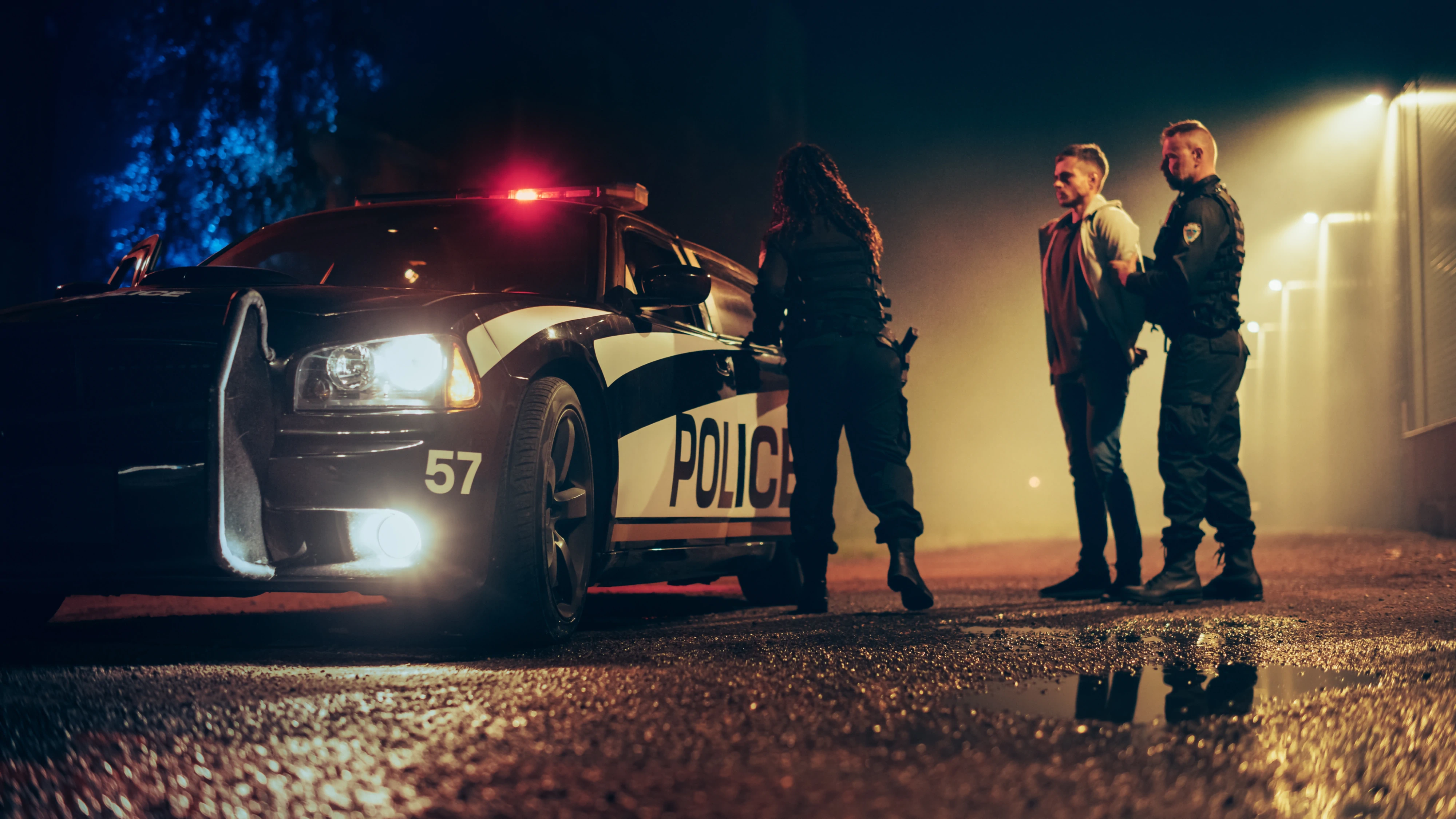
If you've ever been pulled over, stopped on the street, or had police show up at your door, you've encountered these two legal standards — whether you knew it or not. Probable cause and reasonable suspicion are the two thresholds that determine when police in Texas can legally stop you, search your property, or place you under arrest. They're not the same thing, and the difference between probable cause vs. reasonable suspicion can actually have a huge impact on your case.
These concepts aren’t just legal trivia; they’re practical knowledge that protects your constitutional rights. If law enforcement crossed a legal line — whether that means conducting a search without sufficient justification or making an arrest on shaky grounds — that evidence may be suppressible, and your case may be dismissible. Knowing where those lines are is where a strong defense begins.
Arrested? Make sure your rights are protected by contacting Turnbull Legal Group today or calling us at (832) 314-3232 for a free consultation.
What is the difference between reasonable suspicion and probable cause?
The simplest way to understand the difference: reasonable suspicion is a lower bar than probable cause, and each standard unlocks different police powers.
Here's a quick side-by-side comparison of how the two standards work in practice:
Both standards exist for the same reason: to protect you from arbitrary or abusive policing. The Fourth Amendment of the U.S. Constitution prohibits unreasonable searches and seizures, and Texas law mirrors that protection. These standards are how courts enforce that prohibition.
The legal standard behind each term
The legal standard is the evidentiary threshold that must be met before a government action — like a search or an arrest — is considered legally justified. In criminal law, the standard that applies at any given moment determines what police can and cannot do.
These are the main legal standards in Texas criminal law, from lowest to highest:
For purposes of a stop, search, or arrest, the two standards you'll encounter most often are reasonable suspicion and probable cause. Meeting the wrong standard — or failing to meet either — can invalidate everything that follows, including any evidence police collect.
Specific articulable facts: the foundation of both
One phrase comes up constantly in Fourth Amendment law: specific articulable facts. This is the requirement that an officer be able to point to concrete, describable observations — not feelings, not instincts — that support their decision to stop or search someone.
The landmark U.S. Supreme Court case Terry v. Ohio (1968) established this principle. An officer cannot justify a stop simply by saying something "seemed off." They must be able to articulate exactly what they observed, why it suggested criminal activity, and how those facts connect to a reasonable suspicion that a law was being broken.
Specific articulable facts might include things like:
- Observing a driver swerving between lanes at 1:00 a.m.
- Watching a person match the exact description of a suspect from a recent 911 call
- Noticing the smell of marijuana coming from a vehicle during a traffic stop
- Seeing someone repeatedly peer into parked cars in a parking garage
What doesn't qualify: a vague sense that someone "looked suspicious," demographic profiling, or acting nervous when approached by police. Courts routinely reject these as insufficient grounds for a stop or search.
Can reasonable suspicion lead to probable cause?
Yes: A police encounter that begins with only reasonable suspicion can escalate into probable cause based on what officers observe during the stop.
Here's a common example: an officer pulls someone over for swerving (reasonable suspicion of driving while intoxicated). During the stop, the driver slurs their words, smells of alcohol, and fails the field sobriety tests. Those additional observations give the officer probable cause to make a DWI arrest.
This escalation is legal and happens frequently. But there are limits. Police cannot manufacture justification by prolonging a stop beyond its original scope just to go fishing for more evidence. If an officer pulls you over for a broken taillight, they can't detain you for 45 minutes hoping to find a reason to search your car without additional grounds developing during the stop.
If you were stopped for a minor infraction and things escalated quickly, it's worth having an attorney examine the timeline and the basis for each step of the encounter. Whether you're facing a first DWI offense in Texas or a more serious charge, how that stop began matters enormously.
What are some examples of reasonable suspicion?
Reasonable suspicion may be easier to understand through examples than through legal definitions. Courts evaluate these situations case by case, but the following scenarios have generally been found to meet the standard.
- A driver is weaving between lanes, braking erratically, or driving significantly below the speed limit late at night
- A pedestrian matches a detailed description broadcast by dispatch following a nearby crime
- An officer observes what appears to be a hand-to-hand drug transaction
- A person is loitering near a closed business in the early morning hours and flees when they notice police
- A vehicle is parked in a high-crime area at an unusual hour, and the occupant appears to be watching foot traffic
It's worth noting that context matters. The same behavior in two different settings can produce very different legal outcomes. Texas courts try to look at the full picture of what an officer observed, not any single fact in isolation.
Examples of probable cause
Probable cause requires more than just a “reason” to look closer — it requires enough evidence that a reasonable person would believe a crime was committed, is being committed, or is about to be committed. The following are commonly recognized examples.
- Smelling alcohol on a driver's breath and observing bloodshot eyes and slurred speech
- Spotting drug paraphernalia or an open container in plain view inside a vehicle
- Receiving a credible, corroborated tip from a known reliable informant
- Observing someone run from the scene of a reported crime
- Detecting the odor of marijuana or other controlled substances
We should also note that some types of evidence that used to establish probable cause are now legally contested. The use of drug-sniffing dogs, for example, has been the subject of significant litigation in Texas and nationally. Whether a dog alert alone constitutes probable cause depends on the circumstances, the dog's certification record, and how the alert was conducted.
Is reasonable suspicion enough for a search?
Generally speaking, no. Reasonable suspicion alone is not enough to justify a full search of your person, vehicle, or property. It only authorizes a brief, limited detention — and in some cases, a pat-down for weapons (called a Terry frisk) if the officer has reason to believe you may be armed and dangerous.
To conduct a full search, police typically need one of the following:
- Probable cause — a higher evidentiary threshold based on specific facts
- A valid search warrant issued by a judge
- Your voluntary consent to search
- Exigent circumstances — an emergency situation requiring immediate action
- A lawful arrest, which allows a search incident to the arrest
You have the right to refuse consent to a search. Saying "I do not consent to a search" doesn't mean police will stop — but it helps preserve your Fourth Amendment rights and creates a clear record that any subsequent search was conducted without your permission. This matters enormously if your case goes to court.
While not being read a Miranda Warning in Texas doesn’t mean your whole case will be thrown out, the question of what police can legally search, and when, is closely connected to your rights during any police encounter.
When can the police stop, search, or arrest you in Texas?
Texas law tracks the federal constitutional framework closely, but there are important state-specific nuances. Here's when each type of police action is legally authorized:
Texas also has specific statutes governing when an officer can arrest without a warrant. Under Texas Code of Criminal Procedure Article 14.01, a peace officer may arrest a person without a warrant if they witness the commission of a felony or a breach of the peace. This is separate from the warrant-based process, and it has its own set of legal limits that can be challenged.
How an attorney protects you from unreasonable searches and seizures
The Fourth Amendment's protection against unreasonable searches and seizures isn't self-executing. It requires someone to raise the issue, argue it effectively, and present the court with a compelling reason to exclude illegally obtained evidence. That someone is your defense attorney.
Here's what an experienced criminal defense attorney does to challenge unlawful police conduct:
- Investigates the basis for the initial stop to determine whether specific articulable facts existed
- Reviews body camera footage, dashcam video, and police reports for inconsistencies
- Files motions to suppress evidence that was obtained without sufficient legal justification
- Challenges the reliability of informant tips used to establish probable cause
- Examines whether consent to search was genuinely voluntary or coerced
- Scrutinizes the chain of evidence to identify procedural violations
When a motion to suppress succeeds, the consequences for the prosecution can be severe. Evidence obtained in violation of your rights is generally inadmissible under the exclusionary rule — meaning the state can't use it against you at trial. Depending on the case, this can result in an outright dismissal.
Whether you’re facing charges for DWI or you need an attorney who knows how to beat a possession charge in Texas, hiring the best criminal defense lawyer you can is the best thing you can do to protect your future.
Ned Turnbull's background as a former State District Court Judge and Chief Prosecutor gives him a vantage point that most defense attorneys simply don't have. He's reviewed evidence from the bench. He's made charging decisions as a prosecutor. He knows how these cases are built — which means he knows exactly where to look for the cracks.
Probable cause and reasonable suspicion exist to protect you; Turnbull can help make sure they do.
These legal standards aren't bureaucratic formalities. They're the constitutional guardrails that stand between you and government power. When police respect these standards, the system works. When they don't, you need someone who can hold them accountable.
At Turnbull Legal Group, we examine every stop, every search, and every arrest from the ground up. We look at what the officer observed, when they observed it, what they did next, and whether each step was legally justified. If it wasn't, we fight to have that evidence thrown out — and we fight hard.
Ned Turnbull has spent decades on both sides of these cases — as a judge evaluating probable cause in real time, as a prosecutor building cases on it, and now as a defense attorney tearing those cases apart when the standard wasn't met. That kind of inside knowledge isn't something you can learn in a textbook. It's the product of experience, and it's what we bring to every client's defense.
Whether you need a lawyer for a drug case in Houston, a Bryan DWI lawyer or Conroe DWI lawyer, or an assault lawyer to protect your life, we can help. If you've been stopped, searched, or arrested in Texas and you're not sure whether law enforcement followed the rules, don't wait to find out. Contacting Turnbull Legal Group online today or call us at (832) 314-3232 to schedule a consultation and start fighting for your future.
More Helpful Articles by Turnbull Legal Group:
- What is an Aggravated DWI?
- Is a DWI a Felony in Texas?
- How Long Does a DWI Stay on Your Record in Texas?
- What Does a Background Check Show in Texas?
- What You Need to Know About Self-Defense Laws in Texas
.webp)
Give Your Case Home-Court Advantage.
From criminal defense to personal injury, we bring perspective, strategies, and relationships that not many law firms can offer — and we use them to protect your life.